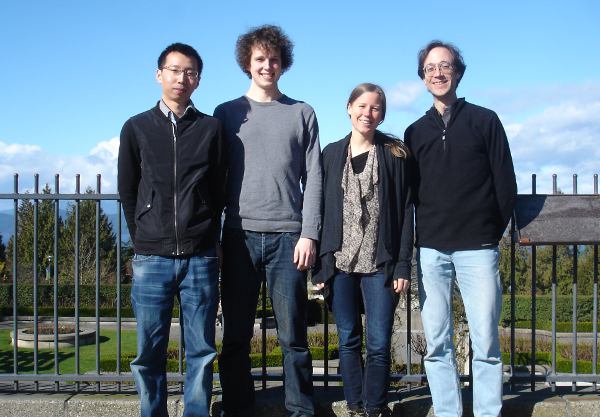
Carl Michal, Associate Professor

Department of Physics and Astronomy Office: Hennings 411, Tel: (604) 822-2432
University of British Columbia Lab: Hennings 100, Tel: (604) 822-3898
6224 Agricultural Road Fax: (604) 822-5324
Vancouver, BC  V6T 1Z1 Email: michal@physics.ubc.ca
Canada

Research Interests

Biological materials

Nephila
clavipes spider

I am interested in the molecular basis of the mechanical properties of biological materials.  Much of our work has focused on the dragline silk of the golden orb weaver (Nephila clavipes).  This outstanding biomaterial has an energy to break greater than Kevlar, yet is synthesized from organic starting materials and is biodegradable.  We use solid-state nuclear magnetic resonance to probe the conformation and dynamics of the various amino acid components of the silk protein. We are currently working with Frank Ko (AMPEL) to investigate genetically engineered silk proteins.

Other materials we are interested in include resilin, an extraordinary rubber made by insects, hagfish slime threads, and whelk egg capsule.

Optical Pumping

At low temperatures, semiconductors like GaAs and InP develop giant nuclear spin polarizations when illuminated by circularly polarized near band-gap light.  Our goal is to harness this large spin polarization to perform structural measurements on biological macromolecules.  Because the mechanisms underlying optical pumping are not completely understood, we are focussing on characterizing the optical pumping behaviour of indium phosphide.

transferred optical pumping

Conducting Polymers

I am involved in a project with John Madden (EECE), Mike Wolf (Chemistry) and Mark MacLaughlin (Chemistry) to develop and characterise materials for use as supercapacitor electrodes. Ultimately we aim for these materials to be used in devices for power storage and power quality applications. Some of these materials also have interesting mechanical properties. Polypyrrole for example expands and contracts as a function of applied voltage, and has been proposed for use as an "artificial muscle."

Two-photon NMR

My group has developed techniques to excite Nuclear Magnetic Resonance without any on-resonance irradiation. This technique allows the acquisition of NMR decays with no receiver dead-time, but at the cost of greatly increased applied rf power. We are currently developing applications of two-photon excitation.

Courses

I am currently teaching Physics 209. For current course information, check here.

Selected Publications

C.A. Michal, S.P. Hastings, L.H. Lee,"Two-photon Lee-Goldburg nuclear magnetic resonance: SImultaneous homonuclear decoupling and signal acquisition." The Journal of Chemical Physics 128, 052301 (2008).

C.H. Tso, J.D. Madden, and C.A. Michal, "An NMR study of PF6- ions in polypyrrole." Synthetic Metals, 157, 460-466 (2007).

L. Goehring and C.A. Michal, "Nuclear spin polarization transfer across an organic-semiconductor interface."Journal of Chemical Physics, 119 10325-10329 (2003).

P.T. Eles and C.A. Michal "Two-photon excitation in nuclear quadrupole resonance," Chemical Physics Letters, 376, 268-273 (2003)

C. A. Michal "Nuclear magnetic resonance noise spectroscopy using two-photon excitation." Journal of Chemical Physics, 118, 3451-3454 (2003).

C. A. Michal and K. Broughton and E. Hansen "A high performance digital receiver for home-built NMR spectrometers." Review of Scientific Instruments. 73, 453-458 (2002).

C. A. Michal and R. Tycko, "Stray-Field NMR Imaging and Wavelength Dependence of Optically Pumped Nuclear Spin Polarization in InP," Physical Review B 60, 8672-8679 (1999).

C. A. Michal and R. Tycko, "Nuclear Spin Polarization Transfer with a Single Radio-Frequency Field in Optically Pumped Indium Phosphide," Physical Review Letters 81, 3988-3991 (1998).

C. A. Michal and L. W. Jelinski, "Rotational-Echo Double-Resonance in Complex Biopolymers: a Study of Nephila clavipes dragline silk," Journal of Biomolecular NMR 12, 231-241 (1998).

C. A. Michal and L. W. Jelinski, "REDOR 3D: Heteronuclear Distance Measurements in Uniformly Labeled and Natural Abundance Solids," Journal of the American Chemical Society 38, 9059-9060 (1997).

A. H. Simmons, C. A. Michal and L. W. Jelinski, "Molecular Orientation and Two-Component Nature of the Crystalline Fraction of Spider Dragline Silk," Science 271, 84-87 (1996).